
Why Western Wisconsin Fleets Choose Dedicated Diesel Service
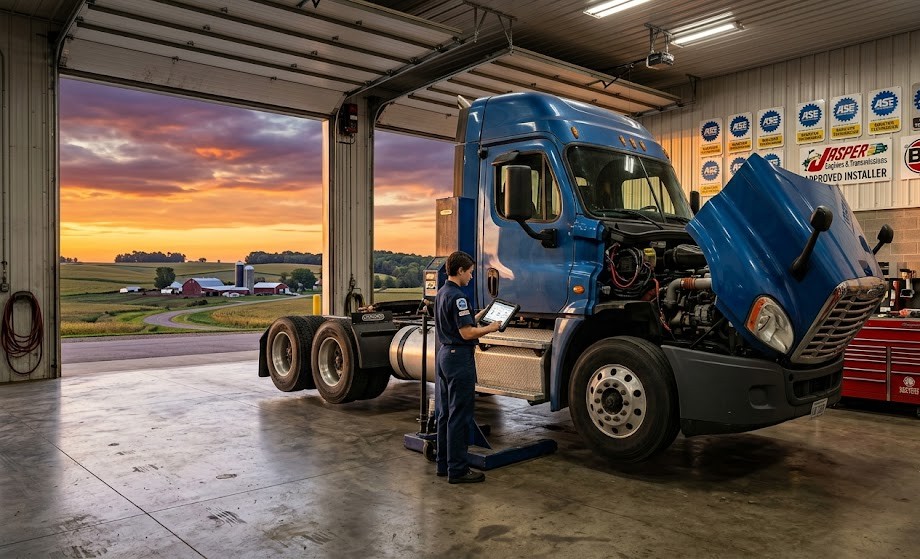
It’s 5:15 in the morning. Your best driver is supposed to be three hours into a run when he calls from the shoulder of I-94 with a fault code he can’t clear. Your general mechanic opens at 8. He can probably fit you in Thursday.
This is the diesel fleet service problem western Wisconsin operators don’t talk about until it’s already costing them. And by the time Thursday rolls around, it’s costing them a lot.
Background and Context
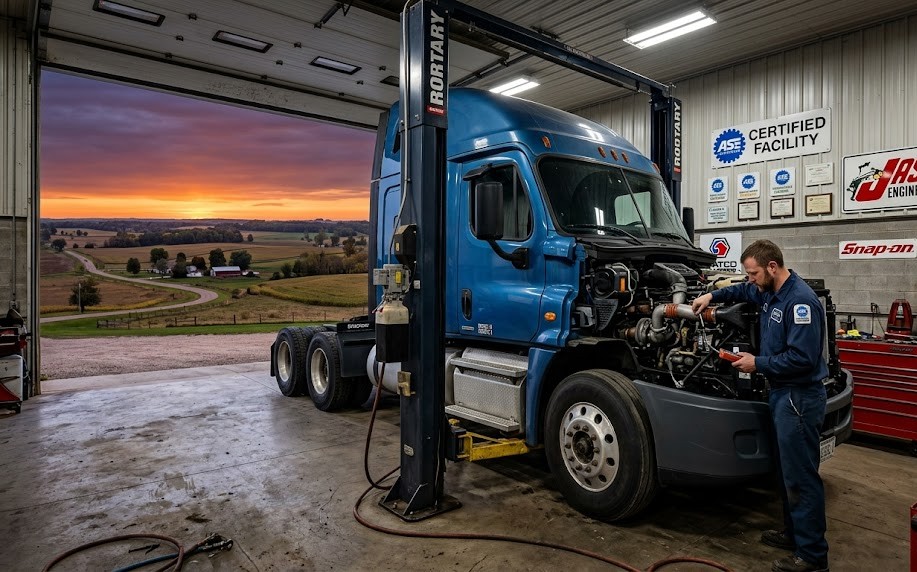
Western Wisconsin isn’t a suburban commuter market. It’s St. Croix County dairy operations running refrigerated loads six days a week. It’s construction contractors hauling equipment from Hudson to Eau Claire on schedules that don’t have room for a four-day wait. It’s regional freight moving through the I-94 corridor connecting the Twin Cities to Chicago, every truck representing a livelihood and a deadline.
Every one of those operations runs on diesel. When diesel goes down, the clock starts immediately.
The American Trucking Associations estimates unplanned downtime costs commercial fleet operators between $448 and $760 per truck per day. Factor in missed load penalties, emergency labor premiums, and the customer relationships that quietly erode with every late delivery, and real-world losses routinely push past $1,000 per truck per day. A shop that splits its time between oil changes on family cars and the occasional diesel job isn’t built to minimize that number.
A dedicated diesel specialist is.
What Diesel Fleet Service Really Costs Western Wisconsin Operators
Most fleet managers track fuel. They track insurance. A disciplined few track tires. Very few track the actual cost of mishandled maintenance, and that’s where general shops quietly drain fleet budgets without anyone noticing until the numbers get ugly.
Here’s what that math actually looks like.
A commercial diesel truck averaging 30,000 miles a year has 30 to 40 scheduled service touchpoints across its working life. Miss the right one, or hand it to a technician who diagnoses an EGR valve fault as a sensor glitch, and that $400 misfire diagnostic becomes a $4,200 EGR replacement. Add the collateral cooling system damage that built up across six weeks of operating with a stuck cooler, and the final bill doesn’t look like a maintenance cost anymore. It looks like a capital expense nobody budgeted for.
Diesel fleet service in western Wisconsin, done right by a diesel-only specialist, is built around preventing exactly that sequence. Not by charging more per visit. By knowing these systems well enough to catch the right problem on the first diagnosis.
Midwest Diesel and Auto in Hammond, Wisconsin structures its fleet work around this principle. The shop specializes in Ford PowerStroke, Cummins, and Duramax platforms because those are the engines powering the majority of the commercial and work truck fleet across St. Croix County and the surrounding region. Knowing one thing well is a choice. It’s also a competitive advantage.
Why ASE-Certified Diesel Technicians Aren’t Just Regular Mechanics
The ASE certification system has specific designations that draw a clear line between general repair knowledge and diesel-specialized expertise. General mechanics typically hold A-series certifications covering light vehicle systems. The T-series, covering medium and heavy truck platforms, is what commercial diesel work actually demands.
T2 certifies diesel engines specifically. T3 covers drive trains. T4 handles brakes on commercial vehicles. T6 addresses electrical systems on trucks that carry wiring complexity far beyond anything in a passenger car. The L2 advanced engine performance designation goes deeper still, into emissions control diagnostics, fuel injection, and the failure patterns that modern tier-4 engines produce.
An ASE-certified diesel technician working at a specialist shop sees these systems every single day. That repetition builds a diagnostic pattern library that no generalist, no matter how talented, can develop splitting time across 20 different vehicle types.
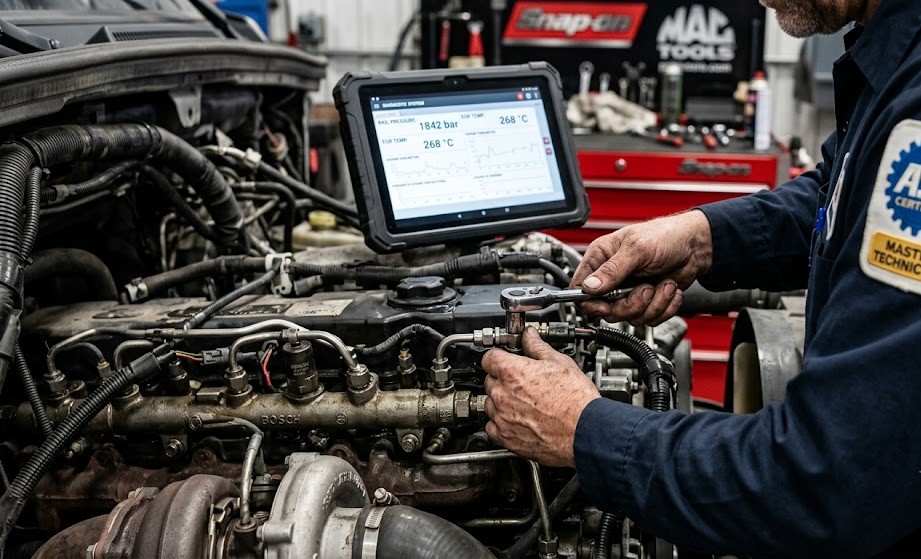
The systems themselves make this non-negotiable. Diesel common-rail injection operates at pressures between 23,000 and 30,000 PSI. A diesel particulate filter clogged by short-trip duty cycles requires a specific forced-regeneration protocol, not a generic smoke test. An SCR system with a DEF dosing fault won’t just throw a code. It will derate the engine in stages until the truck can’t haul a useful load, and a technician who hasn’t seen that sequence before will chase the wrong component.
Midwest Diesel and Auto’s ASE-certified technicians also carry JASPER Engines installer certification, which means the shop meets the quality standards required to install and warranty one of the most respected remanufactured diesel engine programs in the country. That credential exists because JASPER vets the shops it allows to carry its product. It’s a third-party validation of shop quality that a general mechanic can’t simply claim.
Where General Mechanics Fall Short on Diesel Equipment
Let’s be honest about the counterargument. Plenty of general mechanics in western Wisconsin work on diesel trucks and do a competent job. Small communities need versatile shops. Not every county seat has a dedicated diesel specialist, and for simple maintenance on straightforward jobs, a general shop can handle it.
But “competent” is a low bar when your fleet is your business.
The problem with a generalist approach to commercial diesel work isn’t mechanical incompetence. It’s diagnostic pattern recognition. A technician who splits time between intermittent diesel fault codes and brake pad replacements on a Honda builds two different knowledge sets at half the speed of a technician who works exclusively on diesel systems. That matters most in exactly the situations where speed and accuracy cost real money.
Three scenarios break the generalist model every time.
First: intermittent faults with no clean reproduction. A diesel engine producing an intermittent injector balance fault on cylinder 4 of a 6.7 Power Stroke, present only under load at operating temperature, requires someone who has seen that specific failure mode before. A general mechanic starts from scratch. A diesel specialist recognizes the pattern and goes straight to the likely cause.
Second: emissions system failures under time pressure. DPF, EGR, SCR, DEF system faults are the most common source of commercial diesel complaints in Wisconsin. They’re also the most frequently misdiagnosed by technicians without dedicated diesel training. A misdiagnosed emissions fault on a truck under a commercial vehicle inspection deadline isn’t just expensive. It’s a compliance problem.
Third: multi-vehicle fleet diagnostics. When the same root cause shows up differently across several trucks in a fleet, a diesel specialist can identify the pattern. A general mechanic looks at each truck individually and misses the connection entirely.
The Real Downtime Math for Wisconsin Fleet Operators
Here’s how the numbers play out in practice.
A four-truck construction fleet in St. Croix County running at 80 percent utilization generates roughly $3,200 in daily revenue across the operation, assuming industry-average billing rates for the region. One truck down for three days at a general shop that misdiagnoses the fault and has to order the correct part after the fact costs between $2,400 and $3,000 in lost productivity before a single repair invoice gets written.
Add the repair bill itself. Add the time the fleet owner spent on the phone managing the situation. Add the customer who got a delayed delivery and is now taking their next contract to someone else.
The general shop’s lower hourly rate doesn’t survive that math.
A dedicated diesel fleet service provider in western Wisconsin shortens that entire sequence. First-visit diagnostic accuracy is higher because the technician has seen the failure before. Parts inventory is calibrated to the most common diesel failures in the market, not split across a hundred different vehicle makes. And the fleet gets a maintenance record and service history that makes the next diagnostic faster than the one before it.
Midwest Diesel and Auto’s partnerships with BD Diesel, aFe Power, and Baja Designs reflect exactly this kind of market specificity. These aren’t generic parts suppliers. They’re diesel-focused brands that stock the components and upgrades western Wisconsin diesel operators actually need.
What the Data Shows About Diesel Specialist Maintenance
The Technology and Maintenance Council, a division of the American Trucking Associations, has tracked fleet maintenance outcomes for decades. Fleets running structured preventive maintenance programs managed by diesel-certified technicians see unplanned repair events drop 25 to 40 percent compared to reactive, fix-it-when-it-breaks approaches.
That number compounds. A fleet that eliminates two unplanned repair events per truck per year, at average downtime costs of $700 per event per day across a two-day average repair window, saves roughly $2,800 per truck annually. On a four-truck fleet, that’s over $11,000 in recovered productivity before factoring in reduced parts costs from catching problems early.
The Federal Motor Carrier Safety Administration reports that mechanical failure contributes to approximately 10 percent of large truck crashes every year. Brake and engine defects account for the majority of those mechanical failures. Preventive maintenance doesn’t just protect revenue. It protects drivers.
“Diesel engines don’t fail randomly,” one fleet maintenance specialist told Fleet Owner magazine. “They fail because someone missed a pattern they weren’t trained to see.”
That pattern recognition is exactly what separates a shop like Midwest Diesel and Auto from a general mechanic with a diesel truck in the bay once a week. It’s not about effort or intention. It’s about the specialized exposure that turns fault codes into diagnoses on the first try.
Midwest Diesel and Auto opened in Hammond in 2021, founded by people with enough conviction in diesel specialization to bet a business on it in a market that had plenty of general shops already. That’s a statement of confidence in the specialist model. The fleet operators choosing them in St. Croix County and across western Wisconsin are validating it.
What Western Wisconsin Fleet Owners Should Do About Diesel Fleet Service
The decision to move fleet maintenance to a dedicated diesel specialist in western Wisconsin isn’t complicated. The downtime math is clear. The diagnostic accuracy data is clear. The only variable is timing.
For fleets running three trucks or more, the right move is a consultation before the next service interval, not after the next breakdown. A diesel specialist shop evaluates your current service records, identifies any patterns in your fault history, and builds a maintenance schedule around your actual duty cycles and load profiles, not generic mileage charts written for national averages.
If you’re running PowerStroke, Cummins, or Duramax-powered trucks through St. Croix County, Pierce County, or anywhere along the I-94 corridor in western Wisconsin, Midwest Diesel and Auto in Hammond is the specialist shop built for exactly that operation.
454 Co Rd T, Hammond, WI 54015. Call (715) 500-1840. Monday through Friday, 8am to 5pm.
The question isn’t whether a dedicated diesel fleet service provider in western Wisconsin is worth it. The question is how many more misdiagnoses your fleet can afford before you find out.
Conclusion
Diesel fleet service in western Wisconsin is a specialized need, and it deserves a specialized answer. The cost-per-mile math, the downtime risk, the diagnostic accuracy advantage, and the credential stack all point the same direction. Fleet operators who commit to a diesel-only specialist stop chasing repair cycles and start running tighter, more profitable operations. Midwest Diesel and Auto in Hammond, Wisconsin carries the ASE certifications, the JASPER approval, the diesel-specific brand partnerships, and the focused expertise to deliver that for every fleet client in the region. If your trucks are still going to a general shop, you already know what the next breakdown is going to cost. Now you know where to call instead.
FAST FACTS
- 1. Unplanned truck downtime costs fleet operators between $448 and $760 per truck, per day, before lost revenue and penalty clauses are factored in (American Trucking Associations).
- 2. Diesel common-rail injection systems operate at fuel pressures between 23,000 and 30,000 PSI, requiring specialized diagnostic equipment and calibrated expertise not found in general repair environments.
- 3. Fleets with structured preventive maintenance programs run by diesel-certified technicians see unplanned repair events drop 25 to 40 percent compared to reactive maintenance approaches (Technology and Maintenance Council/ATA).
- 4. Mechanical failure contributes to approximately 10 percent of large truck crashes annually in the U.S., with brake and engine defects accounting for the majority of those incidents (Federal Motor Carrier Safety Administration).
- 5. ASE’s T-series certification program covers 9 specialty areas specific to medium and heavy commercial vehicles, including diesel engines, electrical systems, brakes, and drive trains.
- 6. A DPF (diesel particulate filter) replacement runs $2,000 to $5,000 per unit. A proactive cleaning service costs $300 to $500. The difference is diagnostic timing.
- 7. Midwest Diesel and Auto in Hammond, WI is an ASE-certified, JASPER Engines approved installer specializing in Ford PowerStroke, Cummins, and Duramax platforms, serving fleet clients across western Wisconsin.
- 8. St. Croix County, home to Hammond, WI, is among the fastest-growing counties in Wisconsin, with commercial vehicle fleet activity expanding steadily alongside regional construction, agriculture, and freight operations.
FAQ
Q: What makes diesel fleet service in western Wisconsin different from standard truck repair? A: Diesel fleet service focuses exclusively on commercial diesel systems including common-rail injection, DPF, EGR, and SCR emissions controls, and heavy-duty transmissions. A dedicated diesel shop in western Wisconsin builds maintenance schedules around actual regional duty cycles and seasonal conditions. That specialization produces faster diagnoses, higher first-visit accuracy, and significantly lower unplanned downtime compared to a general mechanic dividing attention across multiple vehicle types.
Q: How does an ASE-certified diesel technician differ from a general mechanic for fleet maintenance? A: ASE-certified diesel technicians hold T-series or L2 designations covering medium and heavy truck diesel systems specifically. General mechanics typically hold A-series light vehicle certifications. The gap matters most in complex diagnostics: intermittent faults, emissions system failures, and multi-truck fleet patterns require deep diesel-specific pattern recognition built through repeated, exclusive exposure to these platforms. A general mechanic working on diesel occasionally cannot replicate that depth.
Q: What does fleet downtime actually cost Wisconsin operators per day? A: Industry data from the American Trucking Associations puts unplanned downtime at $448 to $760 per truck per day in direct costs. When missed load penalties, emergency repair premiums, and downstream customer relationship damage are included, losses routinely exceed $1,000 per truck per day. Dedicated diesel fleet service reduces those events through accurate preventive maintenance and faster diagnosis when something does go wrong.
Q: Can a general mechanic handle diesel fleet maintenance effectively? A: For basic routine service on simple diesel vehicles, a competent general mechanic can manage some maintenance tasks. For commercial fleet operations running PowerStroke, Cummins, or Duramax engines under real load, the complexity of emissions systems, high-pressure fuel injection, and multi-vehicle diagnostic patterns makes specialization the measurably safer, lower long-term cost choice. The lower per-visit rate at a general shop rarely survives the math of one misdiagnosis.
Q: Why do western Wisconsin fleet owners choose Midwest Diesel and Auto in Hammond? A: Midwest Diesel and Auto is a dedicated diesel specialist at 454 Co Rd T in Hammond, WI, serving St. Croix County and surrounding western Wisconsin fleet clients. The shop is ASE-certified, JASPER Engines approved, and specializes exclusively in Ford PowerStroke, Cummins, and Duramax platforms. Fleet operators choose Midwest Diesel because the combination of specialized expertise, certified credentials, and diesel-specific parts partnerships produces faster diagnosis, fewer repeat repairs, and lower total cost per mile than any general shop in the region.
Q: What specific diesel systems does a specialist shop handle that general mechanics often miss? A: The most common diagnostic failures at general shops involve diesel emissions systems: DPF (diesel particulate filter) regeneration faults, EGR (exhaust gas recirculation) cooler failures, SCR (selective catalytic reduction) and DEF dosing malfunctions, and common-rail injector balance faults under load. Each requires specific diagnostic protocols and pattern recognition that builds only through dedicated diesel-exclusive experience. These are also the faults most likely to cause engine derates and roadside breakdowns if misdiagnosed.
CALL TO ACTION
Midwest Diesel and Auto exists for people who want the straight story on business, money, and the decisions that actually matter to working Americans. If you run a fleet, own a truck, or care about keeping your operation profitable, subscribe. No filler, no agenda, no algorithm-chasing. Just truth-first coverage from a team that takes your time seriously.