
5 Diesel Engine Warning Signs You Can’t Ignore
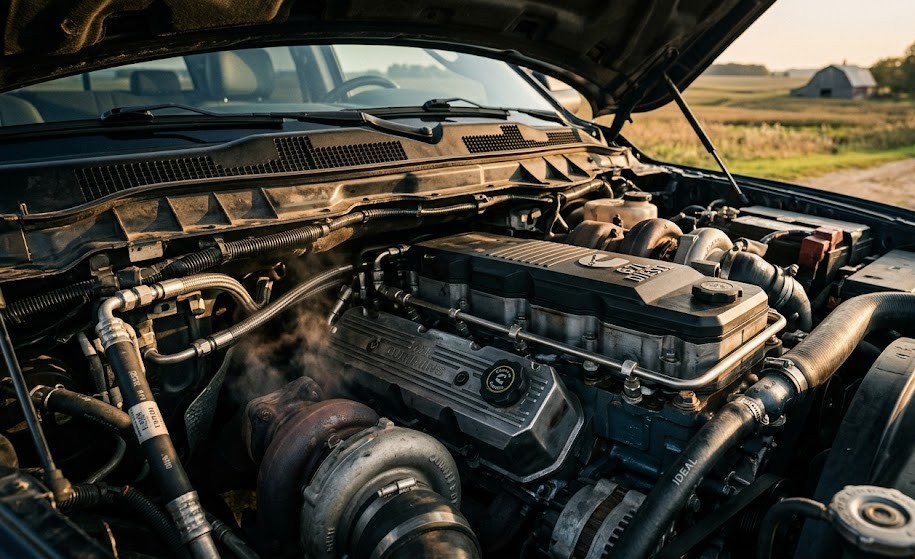
Your diesel engine doesn’t break without warning. It sends signals first. Colored exhaust smoke, a rough idle, a hard crank on a cold morning — these diesel engine warning signs are your truck’s way of telling you a $400 fix is about to become a $4,000 repair if you let it ride. Here’s what to watch for, what each symptom means on your specific platform, and when it’s time to stop guessing and get in front of someone who knows these engines cold.
Background and Context
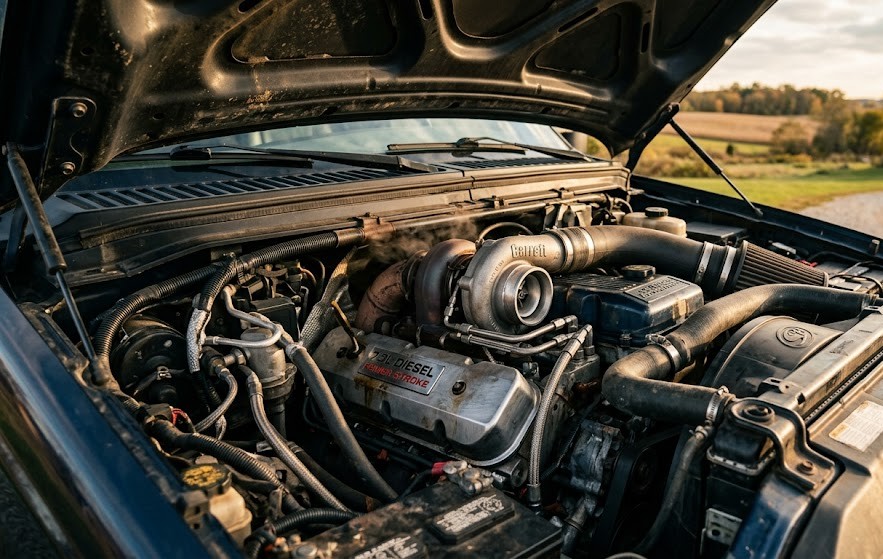
PowerStroke, Cummins, and Duramax engines power the most capable work trucks on American roads. They also carry a reputation for expensive repairs — but only when maintenance gets deferred or symptoms get ignored. The American Trucking Associations has documented consistently that diesel maintenance costs less per mile than gas over a vehicle’s lifetime, but that math only holds when problems get caught early.
In St. Croix County and across western Wisconsin, these trucks pull trailers, haul equipment, run farms, and keep small businesses moving. A breakdown isn’t an inconvenience. It’s lost revenue and a missed deadline. The team at Midwest Diesel and Auto in Hammond, WI sees the same pattern every week: truck owners who noticed something off, waited on it, and turned a straightforward repair into a major job.
The five warning signs below apply across all three platforms. Where the root cause differs by engine, we call it out specifically.
Diesel Engine Warning Signs Every Truck Owner Should Know
No two diesel engines fail the same way. But the signals they send before failure? Those follow a pattern. Learn to read them on your specific platform and you’ll spend far less time in a shop bay than the guy who ignored them.
1. Exhaust Smoke That’s Any Color Other Than Clear
A healthy diesel runs clean. Colored exhaust smoke at startup or under load is your engine communicating something it can’t fix on its own.
Black smoke means the engine is running rich — too much fuel relative to air. On a 6.0 or 6.4 PowerStroke, a clogged EGR cooler is a primary suspect. On the Duramax LLY, a stuck variable-geometry turbo vane generates the same symptom. Cummins engines typically point to faulty injectors or a restricted air intake when black smoke appears under hard acceleration.
White smoke demands more urgency. Coolant or water entering the combustion chamber produces white smoke, and that points to head gasket failure or a cracked cylinder head. The 6.0 PowerStroke is notorious for this failure mode — coolant and exhaust gases mixing through a failed EGR cooler create the exact conditions that destroy head gaskets. If white smoke appears at a cold start and doesn’t clear within 30 seconds, get the truck to a shop. Driving on a failed head gasket is one of the fastest ways to turn a $1,500 repair into an engine replacement.
Blue smoke means oil is burning. Worn piston rings, a failing turbocharger seal, or deteriorated valve stem seals are the usual causes across all three platforms. It’s not catastrophic today — but it moves in that direction quickly if it goes unaddressed.
If you’re seeing any of these PowerStroke diesel problems, Cummins symptoms, or Duramax diagnostic signals, the time to act is before the symptom worsens.
2. Hard Starts, Especially in Cold Weather
Diesel ignition depends on compression heat, not a spark plug. That process is harder in cold temperatures, which is exactly what glow plugs and intake heaters are designed to assist. When starting gets labored — more cranking than it used to take, hesitation before the engine catches — the weather alone isn’t the answer.
On a 7.3 PowerStroke, failing glow plugs are the most common hard-start culprit. On the 5.9 and 6.7 Cummins, a weak lift pump starves the injectors of adequate fuel pressure during startup, making the engine crank longer before it catches. On the Duramax LML, the Bosch CP4 high-pressure injection pump is a documented failure point that often shows hard-start symptoms before it fails outright — and when a CP4 fails catastrophically, it sends metal debris through the entire fuel system.
That last point is critical. A hard start on a Duramax LML isn’t just a nuisance. It can be an early warning for a failure that costs more than $10,000 to remediate fully. If your diesel is cranking noticeably longer than it used to before it fires, a diagnostic appointment is not optional.
3. Sudden Power Loss or Excessive Turbo Lag
A healthy diesel pulls strong and consistent. Whether you’re merging onto a highway or pulling a loaded trailer up a grade, the power delivery should feel controlled and predictable. When your truck suddenly feels soft or sluggish — especially under load — something in the fuel delivery or boost system has changed.
On the 6.7 PowerStroke, a leaking charge air cooler (CAC) bleeds off boost before it reaches the engine, giving you a flat, unresponsive throttle feel under acceleration. On the Duramax, a failing EGR valve creates exhaust backpressure that robs power and often triggers a check engine light. Cummins owners on older 24-valve engines frequently trace sudden power loss to a failing VP44 injection pump; on newer 6.7 platforms, a clogged fuel filter or restricted DPF is the more common cause.
Power loss under load is one of the diesel engine warning signs most often rationalized away. “It’s always pulled a little lazy.” “Maybe I’m just noticing it more.” You’re not imagining it, and it won’t improve on its own. A boost pressure test or fuel trim analysis at Midwest Diesel and Auto will tell you exactly what system is losing efficiency — before that efficiency loss compounds into hardware damage.

The Counterpoint: “It’s Always Run Like This”
The honest pushback from some diesel owners is a fair one: these trucks are louder, smokier, and rougher than gas engines under certain conditions. How do you tell the difference between normal diesel character and an actual problem?
A brief puff of black smoke at hard acceleration on a stock diesel is normal. Some rough idle on a cold first startup is expected. These engines have personality that gas engines don’t.
But there’s a clear difference between normal character and a degrading pattern. Normal doesn’t change. Symptoms do. If a behavior is new, if it’s getting worse over time, or if it’s now happening at conditions where it didn’t before — that’s the signal. A diesel that smoked at wide-open-throttle last year and now smokes at light acceleration has told you something changed. Trust that signal.
4. Fuel Consumption That’s Climbing Without Explanation
You know your truck’s mileage. If you’re filling up more often without a change in driving habits, load, or terrain, pay attention. A 10-15% fuel economy drop on a diesel typically signals a fuel system problem that’s measurable and fixable — if you catch it before it becomes a parts failure.
Injector wear is the most common cause across all three platforms. Worn or leaking injectors dump unburned fuel into the combustion chamber, or worse, into the oil supply. On the 6.0 PowerStroke, injector O-ring failures allow return fuel to contaminate the engine oil — a symptom you can catch by noticing your oil level rising between changes. That’s not a bonus. That’s fuel in your oil, which destroys lubrication film. On the Duramax, worn injector tips cause incomplete combustion that hurts both economy and power. On the Cummins, a failing lift pump reduces rail pressure and forces the high-pressure pump to work harder to compensate, burning more fuel in the process.
Track your fill-ups with a notes app or a notepad in the truck. If your miles-per-gallon has dropped noticeably and nothing else has changed, a fuel system inspection is the next call. Diesel truck maintenance at this level costs a fraction of what a full injector replacement runs.
5. Unusual Noises: Knock, Tick, or Whine That Wasn’t There Before
Diesel engines aren’t quiet. But they’re consistent. The moment a new sound appears — something that wasn’t part of your truck’s normal soundtrack — it’s communicating.
A deep knock that intensifies under load often signals injector knock. On the 7.3 PowerStroke, this is commonly tied to failing HEUI injectors, which rely on engine oil pressure to actuate. When those injectors start failing, the knock is unmistakable at idle and gets worse under acceleration. On the 6.7 Cummins, an injector tick at idle can indicate internal wear that will eventually spike fuel return rates and accelerate injector failure across all cylinders. On the Duramax, a tick or whine from the CP4 injection pump is not a sound to monitor — it’s a sound to act on immediately, because CP4 failure can send metal debris through the entire high-pressure fuel circuit, requiring replacement of injectors, fuel lines, rails, and the pump itself.
A high-pitched whine from the turbocharger that wasn’t there last month often indicates a failing bearing or a compressor wheel beginning to contact the housing. Turbos on these platforms are not inexpensive. Catching a bearing failure early costs a fraction of replacing a destroyed turbo and decontaminating the intercooler and intake tract of oil.
Get these sounds diagnosed by someone who knows the difference between normal diesel character and a platform-specific failure mode. Experience with these three engines specifically matters.
What the Data Shows on Deferred Diesel Maintenance
The Technology and Maintenance Council of the American Trucking Associations has documented consistently that deferred maintenance costs fleet operators roughly 40% more over the long term than proactive servicing. For individual truck owners, the numbers tell the same story at a smaller scale.
A $150 fuel filter replacement avoided becomes a $2,200 lift pump and injector service. A $300 EGR cleaning skipped becomes a $1,800 cooler failure and head gasket job on a 6.0 PowerStroke. A hard-start symptom on a Duramax LML that gets ignored until the CP4 fails outright routinely results in repair estimates that exceed $10,000.
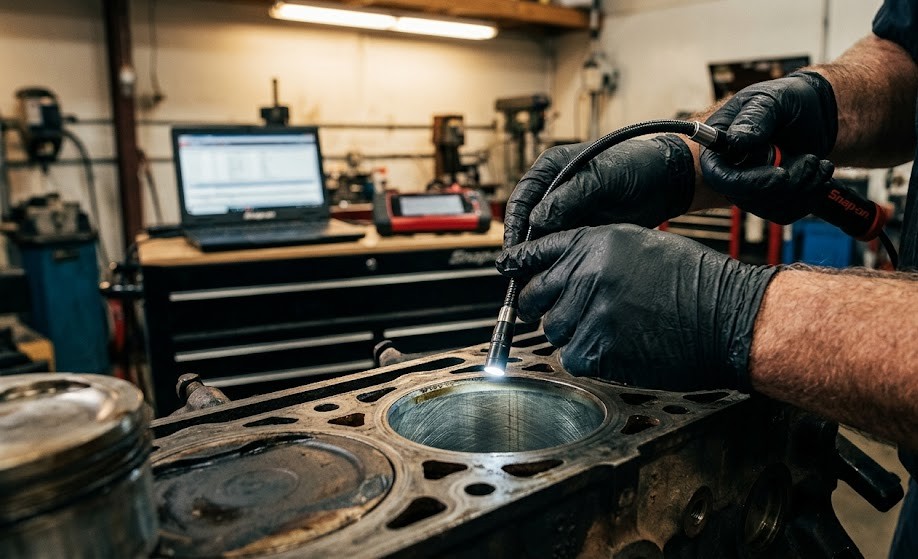
The diesel mechanics at Midwest Diesel and Auto in Hammond, WI service PowerStroke, Cummins, and Duramax trucks daily. Their diagnostic process is built around identifying the root cause, not just the visible symptom — because treating the symptom while missing the cause is how truck owners end up back in the shop two months later. That specificity is what separates a genuine diesel shop from a general repair facility that also happens to own a diesel scan tool.
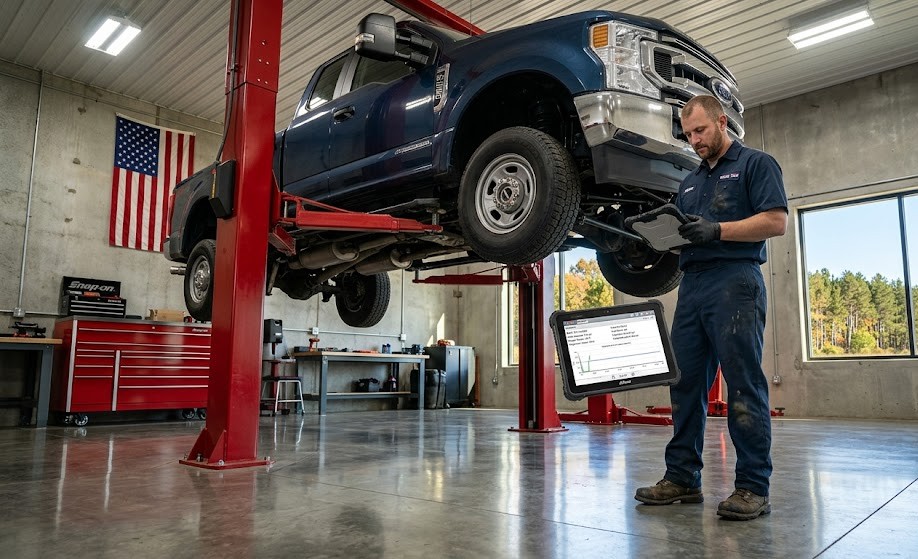
What Happens If You Keep Waiting
Colored exhaust smoke ignored long enough turns a $500 EGR cooler service into a $3,500 head gasket replacement. A CP4 hard-start warning left unaddressed becomes a complete fuel system rebuild. An injector knock that gets written off becomes a freshly damaged engine with oil contaminated by diesel fuel.
The pattern is consistent across all three platforms and every failure mode: small problems are cheap. Big problems are very expensive. The window between the two is shorter than most truck owners expect, and it closes faster when the truck is working hard.
If you’re in Hammond, River Falls, New Richmond, Baldwin, or anywhere in St. Croix County, the team at Midwest Diesel and Auto knows these engines. They’ll give you a straight answer on what your truck actually needs, not what’s easiest to sell. Book a diagnostic appointment at MidwestDieselandAuto.com before a manageable problem becomes an expensive one.
Conclusion
Diesel engine warning signs don’t resolve themselves. Exhaust smoke, hard starts, power loss, rising fuel consumption, and new noises are all your truck telling you something specific — and every platform tells it differently. Whether you’re running a PowerStroke, Cummins, or Duramax, the cost of a diagnostic is always less than the cost of ignoring what you already know is off. Midwest Diesel and Auto in Hammond, WI gives St. Croix County truck owners the straight truth on what their engine needs. Book your appointment at MidwestDieselandAuto.com and know exactly what you’re dealing with before small turns into expensive.
FAST FACTS
- 1. The Ford 6.0 PowerStroke has a documented pattern of EGR cooler failure that allows coolant and exhaust gases to mix, creating the exact conditions that destroy head gaskets — a repair that averages $3,000-$5,000 at a diesel specialist.
- 2. Bosch CP4 injection pump failures on 2011-2016 Duramax LML engines can send metal debris throughout the entire high-pressure fuel system; full remediation regularly exceeds $10,000 in parts and labor.
- 3. A single leaking diesel injector can allow fuel to enter the engine oil supply, reducing lubrication effectiveness and accelerating wear across every surface the oil touches.
- 4. Diesel fuel filters on most PowerStroke, Cummins, and Duramax platforms should be replaced every 10,000-15,000 miles; neglecting this interval is one of the leading causes of lift pump failure and injector damage.
- 5. The 5.9 and 6.7 Cummins engines are consistently rated among the most durable diesel platforms on the market — when maintained on schedule. Most high-mileage failures trace directly to deferred maintenance, not inherent design flaws.
- 6. According to the Technology and Maintenance Council, deferred maintenance costs operators approximately 40% more over the long term than proactive service intervals.
- 7. Turbocharger bearing failures in diesel trucks most often result from oil starvation caused by extended oil change intervals or combustion contamination in the oil supply — a problem that starts long before the turbo whine appears.
- 8. A diesel engine running 10-15% worse fuel economy than its baseline is a measurable, diagnostic finding — not a sign of age. It points to a specific failure in the fuel or air delivery circuit.
FAQ
Q: What are the most common diesel engine warning signs? A: The five most common diesel engine warning signs are colored exhaust smoke (black, white, or blue), hard starts especially in cold weather, sudden power loss or increased turbo lag under load, unexplained fuel consumption increases, and new knocking, ticking, or whining noises. Each symptom points to a specific system problem and should be diagnosed by a diesel specialist before the issue escalates into a major repair.
Q: What does white smoke from a diesel exhaust mean? A: White smoke from a diesel exhaust typically means coolant or water is entering the combustion chamber, most often from a failed head gasket or cracked cylinder head. The 6.0 PowerStroke is particularly prone to this failure due to EGR cooler design. If white smoke persists more than 30 seconds after a cold start, have the truck inspected immediately. Continuing to drive risks catastrophic engine damage.
Q: How do PowerStroke, Cummins, and Duramax warning signs differ? A: The five core warning signs apply across all three platforms, but root causes differ by engine. PowerStroke trucks frequently develop EGR cooler failures and injector O-ring leaks. Cummins engines commonly experience lift pump and injection pump issues. Duramax engines are prone to CP4 pump failure and stuck EGR valves. A shop experienced with all three platforms will identify the right failure for your specific engine rather than applying a generic diagnosis.
Q: Is it safe to drive a diesel with warning signs? A: It depends on the symptom. A brief puff of black smoke under hard acceleration may allow limited driving, but white smoke, severe power loss, a CP4 pump whine on a Duramax, or deep injector knock should stop you from driving. Continuing to operate a diesel with serious warning signs routinely turns a $400 repair into a $4,000 rebuild. When uncertain, book a diagnostic before driving further.
Q: How often should I have my diesel engine inspected? A: Most diesel specialists recommend a diagnostic inspection every 25,000-30,000 miles or annually, whichever comes first. If you notice any of the five warning signs above — smoke, hard starts, power loss, rising fuel consumption, or new noises — bring the truck in immediately rather than waiting for a scheduled service interval. Early diagnosis on PowerStroke, Cummins, and Duramax engines consistently costs less than reactive repair.
CALL TO ACTION
If your PowerStroke, Cummins, or Duramax is showing any of these warning signs, don’t guess at it. The diesel specialists at Midwest Diesel and Auto in Hammond, WI give you a straight diagnostic, a clear answer, and a repair plan built around what your truck actually needs. Book your appointment at MidwestDieselandAuto.com — and know what you’re dealing with before it gets expensive.
Article created by StucciCreations.com