

Diesel vs Gas Trucks: The Ultimate Showdown for Power, Economy and Value in 2025
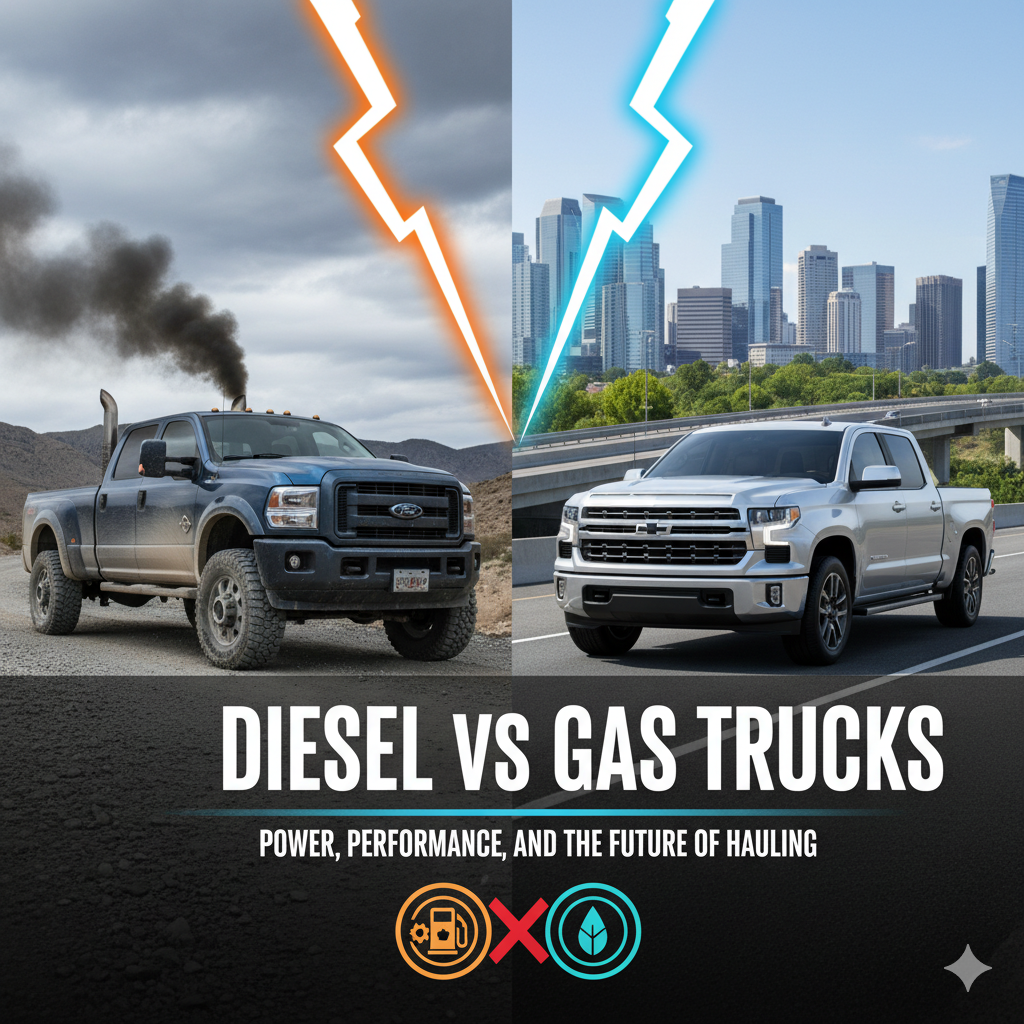
Truck buyers face a critical choice between diesel and gas engines that impacts everything from initial cost to long-term value – our comprehensive analysis cuts through manufacturer hype to reveal which option truly delivers for your specific needs.
America’s love affair with powerful pickup trucks faces a crucial crossroad in 2025: diesel vs. gas trucks. With diesel engines commanding price premiums upwards of $8,500 over their gas counterparts, truck buyers need more than marketing hype to justify that investment. Our deep dive reveals surprising shifts in this decades-old debate that might challenge everything you thought you knew about truck ownership.
The debate between diesel and gasoline truck engines has raged for decades among truck enthusiasts from Milwaukee to Miami, with passionate advocates on both sides. Traditionally, diesel trucks dominated the heavy-duty towing market, while gas-powered pickups ruled daily driving and lighter-duty applications. Today’s landscape, however, shows significant technological evolution in both camps.
Lynch Truck Center in Waterford offers both options across multiple manufacturers, giving buyers the perfect opportunity to compare real-world differences. Modern advancements have narrowed many performance gaps while introducing new considerations around emissions, maintenance, and resale value.
With average new truck prices exceeding $60,000, consumers need clarity on whether investing in diesel technology truly delivers returns or if today’s advanced gas engines offer better value. This question becomes especially critical as more truck owners use their vehicles for both work and personal transportation rather than purely commercial applications.
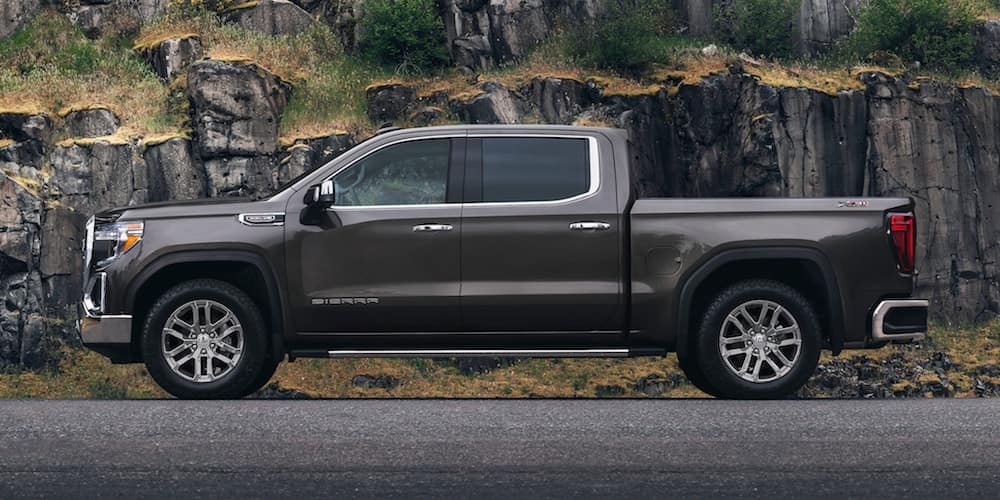
The Power Battle: Diesel vs. Gas Trucks Performance Comparison
The fundamental difference between diesel and gas trucks lies in how they generate power. Diesel engines create combustion through compression alone, while gas engines require spark plugs to ignite the fuel-air mixture. This mechanical distinction creates cascading differences in performance characteristics that directly impact your driving experience.
Torque and Towing Capacity
Diesel engines remain the undisputed torque champions, generating significantly higher torque at lower RPMs than comparable gasoline engines. This translates to superior towing performance, particularly when hauling heavy loads uphill or over long distances. Modern diesel trucks can tow up to 30,000 pounds, far outpacing most gas trucks that typically max out between 13,000-21,000 pounds.
“The difference becomes most apparent when towing at highway speeds through mountainous terrain,” says Mike Henderson, certified diesel technician at Rocky Mountain Diesel. “A diesel maintains consistent power delivery without constantly hunting for gears, unlike many gas trucks that struggle to maintain speed under heavy loads.”
Horsepower and Acceleration
While diesel trucks dominate in torque, gasoline engines typically deliver better horsepower-to-weight ratios and superior acceleration. This makes gas trucks more responsive in stop-and-go traffic and highway passing situations when not heavily loaded. The lighter weight of gas engines also contributes to higher payload capacities in some truck configurations, since the engine itself consumes less of the vehicle’s total weight capacity.
For 2025 models, the performance gap has narrowed significantly. Ford’s 7.3L gas V8 “Godzilla” engine delivers impressive torque figures that approach diesel territory while maintaining the acceleration advantages of gasoline power. Meanwhile, RAM’s 6.4L HEMI and Chevy’s 6.6L V8 have both received significant upgrades to close the performance gap with their diesel stablemates.
Economics: The True Cost Equation of Diesel vs. Gas Trucks
Purchase Price Differential
The initial cost difference between diesel and gas trucks remains substantial in 2025. A diesel engine option typically adds 8,000−10,000 to the purchase price of an otherwise identically equipped truck . This premium creates a significant hurdle that potential diesel buyers must overcome through operational savings or higher resale value.
Fuel Economy Realities
Diesel trucks typically deliver 20-30% better fuel economy than their gasoline counterparts, with the advantage growing more pronounced under heavy loads. However, this efficiency advantage must be weighed against higher diesel fuel prices, which have historically fluctuated more dramatically than gasoline.
For 2025, the national average shows diesel fuel prices approximately 15% higher than regular gasoline. This means a truck delivering 25% better fuel economy will still provide net savings, but the margin is narrower than raw MPG figures might suggest.
Maintenance and Repair Considerations
Modern diesel engines require less frequent basic maintenance than gasoline engines, with longer intervals between oil changes and fewer components like spark plugs to replace. However, when repairs are needed, diesel service typically costs significantly more due to:
- More expensive replacement parts
- Higher-priced specialty fluids and additives
- More complex emissions systems with expensive components
- Fewer qualified technicians, commanding higher labor rates
Gas truck maintenance follows a more predictable schedule with more frequent but less costly service intervals. Major repairs, when needed, typically cost 20-30% less than comparable diesel repairs.
Resale Value Advantage
Diesel trucks traditionally hold their value better than gas models, depreciating approximately 10-15% less over a five-year ownership period. This residual value advantage can substantially offset the higher initial purchase price for owners who trade vehicles regularly.
However, this gap has been narrowing as gasoline engine technology advances. The resale premium for diesel trucks dropped from approximately 60-65% of the original price differential in 2020 to 45-50% in current market conditions, according to industry data.
Practical Considerations: Living With Your Choice Daily
Fuel Availability and Convenience
Gasoline availability remains ubiquitous nationwide, with virtually every fuel station offering multiple grades. Diesel fuel, while widely available along major transportation corridors and in rural areas, can be scarcer in some urban environments. This difference rarely impacts daily driving but may require additional planning during long road trips through unfamiliar territory.
Cold Weather Performance
Modern diesel technology has largely overcome historical cold-weather starting issues through advanced glow plug systems, improved fuel heaters, and better battery technology. However, in extreme cold environments (below -10°F), diesel trucks may still require additional preparation or equipment that gas trucks don’t need.
“Today’s diesel cold-start technology is incredibly advanced compared to even ten years ago,” explains Sarah Martinez, fleet manager at Merchants Fleet. “But in extreme northern climates, you’ll still want block heaters or fuel additives during the coldest months – precautions gas truck owners can generally skip.”
Noise, Vibration and Harshness (NVH)
The stereotype of loud, clattering diesel engines belongs to a bygone era. Contemporary diesel trucks have narrowed the refinement gap dramatically, with advanced insulation, precision fuel injection, and computer-controlled combustion making many diesel trucks nearly as quiet as their gas counterparts at highway speeds.
Inside the cabin, the differences are minimal in premium trims, though gas engines still maintain a slight edge in overall refinement at idle and during heavy acceleration.
Expert Insights
Robert Thompson, Senior Product Specialist at Ford Motor Company, offers perspective on changing consumer preferences: “We’re seeing customers become increasingly sophisticated about matching their truck choice to their actual usage patterns rather than making emotional decisions. Someone towing a 10,000-pound trailer twice yearly but commuting daily in their truck has very different needs than a commercial operator towing 15,000 pounds five days a week.”
Dr. Karen Williams, automotive engineering professor at Michigan Technological University, explains the technological convergence: “The gap between diesel and gasoline performance continues to narrow. Gas engines are adopting diesel-like technologies such as direct injection and higher compression ratios, while diesel engines have dramatically improved their emissions profiles and refinement. Each powertrain still has natural advantages, but the distinctions are becoming more nuanced.”
Industry analyst Mark Davidson of Automotive Research Associates notes changing economics: “The traditional diesel advantage has been undercut somewhat by volatile fuel pricing and increasing maintenance complexity. The ‘diesel premium’ in purchase price requires more careful calculation than ever to justify for many buyers. We’re seeing more consumers opt for high-output gas engines unless their towing needs absolutely demand diesel capability.”
James Rodriguez, a contractor from Chicago, recently faced the diesel vs. gas decision when replacing his aging work truck. “I’d always assumed diesel was the only serious choice for someone who tows regularly,” he explains. “But when I ran the actual numbers for my typical 12,000-pound trailer loads and 25,000 annual miles, the math didn’t clearly favor either option. I ultimately chose diesel for the better towing experience, but it was much closer than I expected.”
The Wilson family from Colorado took a different approach for their recreational needs. “We pull a 9,500-pound RV about eight weekends a year,” says Jennifer Wilson. “After comparing options, we saved $9,000 upfront by choosing a gas truck with the Max Towing Package instead of diesel. The fuel economy difference on our towing weekends doesn’t come close to offsetting that initial savings, especially since our daily commutes are short.”
These real-world examples highlight how personal usage patterns dramatically impact which engine technology makes more economic sense for individual owners.
Balanced Perspective
While this analysis presents the objective advantages of each powertrain type, it’s important to acknowledge that the “right” choice remains highly individualized. Diesel engines continue offering clear advantages for frequent heavy towing, especially over mountainous terrain or long distances. Their superior torque delivery and engine braking capabilities reduce transmission strain and enhance driver confidence when handling substantial loads.
Conversely, gasoline engines offer compelling advantages for buyers whose trucks split time between occasional towing and daily transportation. Lower acquisition costs, simpler maintenance requirements, and more responsive unloaded performance make gas trucks attractive to the growing segment of “lifestyle” truck owners who value versatility over specialized capability.
The environmental impact comparison also presents a mixed picture. While diesel engines typically produce less carbon dioxide due to better fuel efficiency, they generate more nitrogen oxides and particulate matter. Modern emissions equipment has narrowed this gap considerably, but environmental considerations may factor into buyer decisions alongside performance and economic factors.
Conclusion
The diesel vs. gas trucks debate continues evolving as technology advances on both sides. For buyers in 2025, the decision requires honest assessment of how their truck will actually be used rather than relying on traditional assumptions or brand loyalty. Heavy-duty towing applications still favor diesel power, while mixed-use and lighter duty applications may benefit from gasoline’s lower acquisition costs and simpler maintenance.
The performance gap between diesel vs. gas trucks has narrowed significantly, making personal priorities and usage patterns more important than ever in determining which option delivers better overall value. By understanding the specific strengths and limitations of each powertrain type, today’s truck buyers can make informed decisions that align with both their practical needs and financial realities.
FAQ Section
Q: How much more does a diesel truck cost compared to a gas truck?
A: In 2025, the diesel engine option typically adds 8,000−10,000 to the purchase price of an otherwise identically equipped truck. This premium varies slightly between manufacturers and models, with heavy-duty trucks (3/4 ton and 1-ton) showing larger differentials than half-ton models.
Q: Which is better for towing: diesel or gas trucks?
A: Diesel trucks maintain a significant advantage for heavy towing applications due to their higher torque output and better engine braking capabilities. Modern diesel trucks can tow up to 30,000 pounds, while comparable gas trucks typically max out between 13,000-21,000 pounds. The diesel advantage becomes more pronounced when towing in mountainous terrain or over long distances.
Q: Are diesel trucks more fuel efficient than gas trucks?
A: Yes, diesel trucks typically deliver 20-30% better fuel economy than their gasoline counterparts. This advantage grows even more significant when towing heavy loads, where diesel efficiency might drop only 25% while gasoline efficiency can drop 35-40%. However, higher diesel fuel prices partially offset this efficiency advantage in the overall operating cost calculation.
Q: Do diesel or gas trucks last longer?
A: Properly maintained diesel engines typically last longer than gasoline engines, with many reaching 300,000-500,000 miles before requiring major overhaul. Comparable gasoline truck engines more commonly reach 200,000-300,000 miles. This longevity difference contributes to diesel trucks’ traditionally stronger resale values but must be weighed against higher maintenance costs over the ownership period.
Q: Which has lower maintenance costs: diesel or gas trucks?
A: Gas trucks generally have lower overall maintenance costs despite requiring more frequent basic service. Diesel maintenance intervals are longer, but when repairs are needed, they typically cost 20-30% more than comparable gas truck repairs due to more expensive parts, specialized fluids, and higher labor rates for diesel-certified technicians.